France is introducing new e-reporting obligations for businesses that are not established for VAT purposes in France. While such businesses are outside the French e-invoicing requirement, they may still be subject to e-reporting for certain French transactions.
For foreign businesses, there are essentially two questions to consider: from when do the new rules apply, and which French transactions need to be reported?
We have summarized both points below.
In brief
All companies registered for VAT in France without being established there need to check whether they fall under the newly introduced e-reporting obligation. For output transactions, there are thresholds according to the company's size (which can make that the obligation is applicable as from 1 September 2026 or 1 September 2027). For input transactions under reverse charge, the obligation occurs as from 1 September 2027.
1. From when do the rules apply?
For sales and services for which a foreign business is itself liable for French VAT, the starting date depends on the size of the business:
- 1 September 2026 for large enterprises and intermediate-sized enterprises (ETIs);
- 1 September 2027 for micro-enterprises, very small enterprises and SMEs.
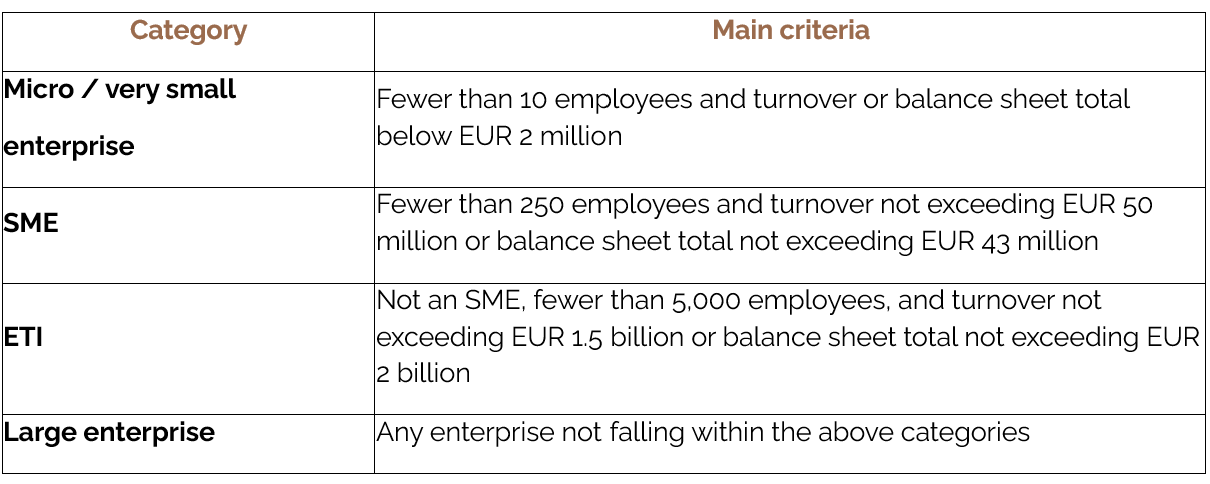
Important: the size test is based on the relevant legal entity as a whole, including its worldwide turnover. It is not determined by the turnover generated in France alone.
In principle, the relevant size category is assessed as of 1 January 2025 based on the most recently closed financial year preceding that date. The French rules take into account the company's employee headcount, annual turnover and balance sheet total.
Main size thresholds
For certain purchase-side transactions, the timing is different: the e-reporting obligation starts on 1 September 2027 irrespective of the size of the business. This includes, in particular, certain transactions subject to French reverse charge and intra-Community acquisitions in France.
2. Which transactions are affected?
For a foreign business without a fixed establishment in France, the main transactions potentially in scope are set out below:
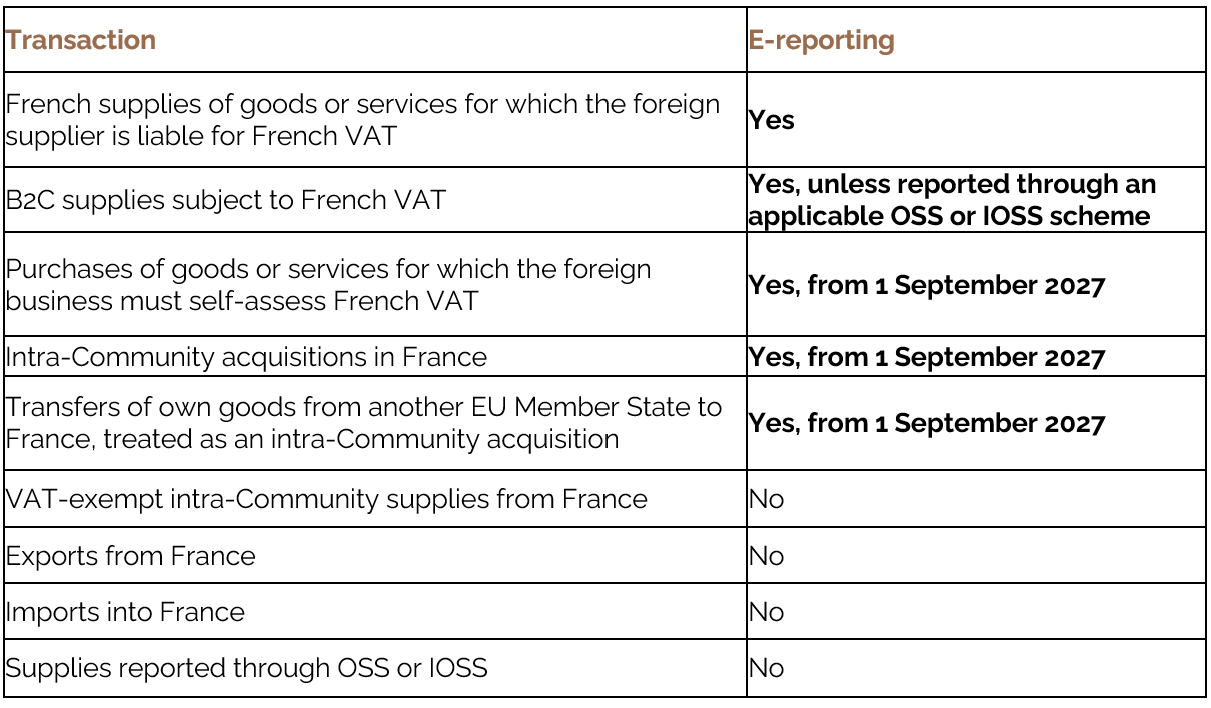
Importantly, where the French reverse-charge mechanism applies because the customer is identified for VAT purposes in France and is required to self-assess the French VAT, the foreign supplier does not have an e-reporting obligation for that transaction. The e-reporting obligation rests with the customer. As a result, foreign suppliers whose French sales are fully subject to the reverse-charge mechanism may have no supplier-side e-reporting obligations in France.
In addition, payment data may need to be reported for certain services and advance payments where French VAT becomes due upon collection. Businesses within scope will also need to use an accredited platform (plateforme agréée) or a supplier who has an agreement with an accredited platform to provide the service to transmit the required data to the French tax authorities.
3. Next steps
For many foreign businesses, the immediate impact will therefore depend primarily on whether they make French supplies for which they are themselves liable for French VAT. Where their French sales are fully subject to the reverse-charge mechanism, there may be no supplier-side e-reporting obligation.
From 1 September 2027, however, purchase-side transactions become particularly relevant, as reverse-charge purchases, intra-Community acquisitions and transfers of own goods into France will also need to be reported, irrespective of company size.
We would be happy to discuss your main French transaction flows. This will allow us to determine whether and from when the new requirements apply, and to identify together the most appropriate practical solution for meeting the new reporting obligations at a reasonable cost.
Please do not hesitate to contact us if you would like to discuss any of the above in more detail.